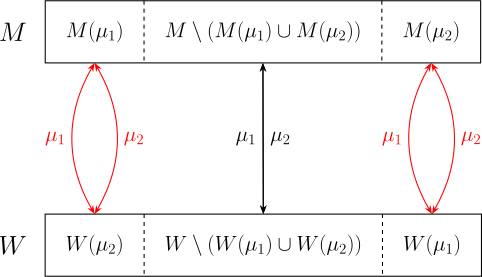
除了在异性之间相互比较之外,每个人还会将自身加入到这个偏好顺序中.这表示,这个人只会接受比单身更偏好的异性;这些异性称为 可接受的(acceptable).显然,不可接受的异性的偏好顺序是无足轻重的;原则上,只需要给出可接受的异性之间的偏好顺序即可.所以,这些存在不可接受异性的偏好也称为列表不完整的偏好(preferences with incomplete lists).
#include<iostream>#include<queue>#include<vector>// Solver for stable marriage problems.// Assume strict preferences with incomplete lists.structStableMatching{intnx,ny;std::vector<std::vector<int>>pref_x,pref_y;// Preferences: preferred first, only acceptable.std::vector<int>match_x,match_y;// Matching: -1 means unmatched.StableMatching(intnx,intny):nx(nx),ny(ny),pref_x(nx),pref_y(ny),match_x(nx,-1),match_y(ny,-1){}// Gale-Shapley algorithm.// Complexity: O(nx * ny).voidsolve(){// Compute Y's ranks over X.std::vector<std::vector<int>>ranks(ny,std::vector<int>(nx));for(intj=0;j!=ny;++j){for(inti=0;i!=(int)pref_y[j].size();++i){ranks[j][pref_y[j][i]]=nx-i;}}// Initialize.std::vector<int>waitlist(ny);// Best proposal rank for j in Y.std::vector<int>ids(nx);// Next j in Y for i in X to propose to.std::queue<int>q;// Currently active i's in X.for(inti=0;i!=nx;++i)q.push(i);// Loop.while(!q.empty()){autoi=q.front();q.pop();if(ids[i]==(int)pref_x[i].size())continue;// List exhausted.autoj=pref_x[i][ids[i]++];if(ranks[j][i]>waitlist[j]){if(waitlist[j])q.push(pref_y[j][nx-waitlist[j]]);waitlist[j]=ranks[j][i];}else{q.push(i);}}// Output.for(intj=0;j!=ny;++j){if(waitlist[j]){inti=pref_y[j][nx-waitlist[j]];match_x[i]=j;match_y[j]=i;}}}};voidsolve(){// Input.intn;std::cin>>n;StableMatchingsolver(n,n);for(intj=0,x;j<n;++j){auto&cur=solver.pref_y[j];std::cin>>x;for(inti=0;i<n;++i){std::cin>>x;cur.push_back(x-1);}}for(inti=0,y;i<n;++i){auto&cur=solver.pref_x[i];std::cin>>y;for(intj=0;j<n;++j){std::cin>>y;cur.push_back(y-1);}}// Solve the problem.solver.solve();// Output.for(inti=0;i<n;++i){std::cout<<(i+1)<<' '<<(solver.match_x[i]+1)<<'\n';}}intmain(){std::ios::sync_with_stdio(false),std::cin.tie(nullptr);intt;std::cin>>t;for(;t;--t){solve();}return0;}
Gale, David, and Lloyd S. Shapley. "College admissions and the stability of marriage." The American Mathematical Monthly 69, no. 1 (1962): 9-15.
Irving, Robert W. "An efficient algorithm for the stable roommates problem." Journal of Algorithms 6, no. 4 (1985): 577-595.
Knuth, Donald Ervin. "Mariages stables et leurs relations avec d’autres problèmes combinatoires." Les Presses de l’Université de Montréal (1976).
McVitie, David G., and Leslie B. Wilson. "Stable marriage assignment for unequal sets." BIT Numerical Mathematics 10, no. 3 (1970): 295-309.
Roth, Alvin E., and Marilda Sotomayor. "Two-sided matching." Handbook of game theory with economic applications 1 (1992): 485-541.
Roth, Alvin E. "Deferred acceptance algorithms: History, theory, practice, and open questions." International Journal of Game Theory 36, no. 3-4 (2008): 537-569.